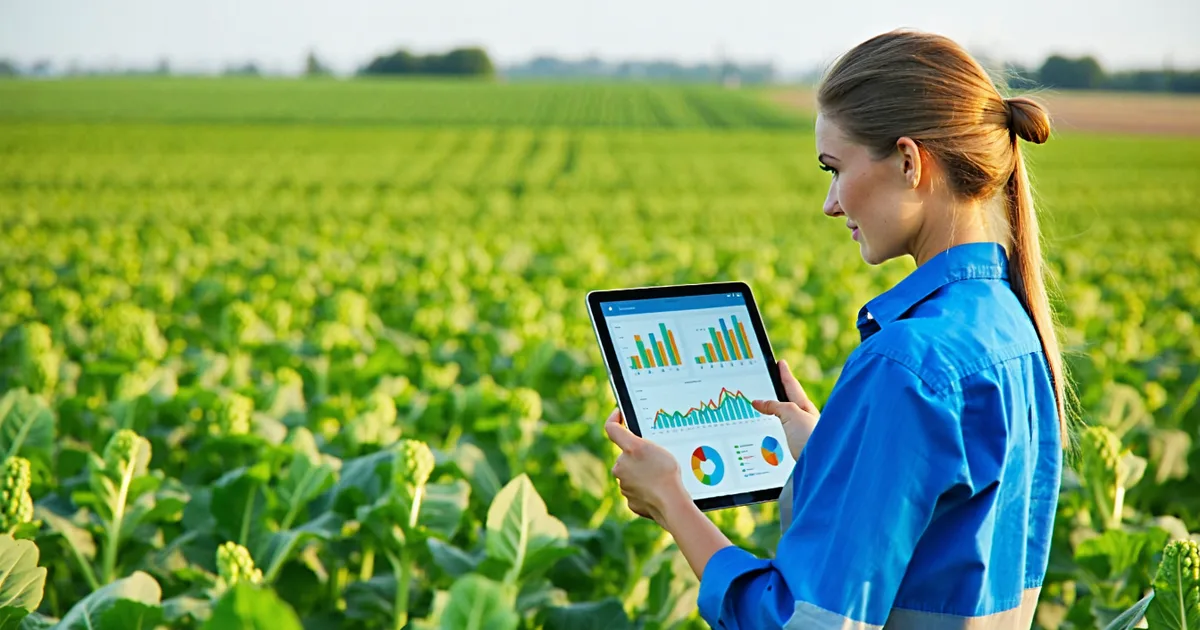
The time crunch that hits consulting agronomists every May and June in Iowa is not new, and it's not a personal productivity problem. It's a structural mismatch between the number of client acres that need attention in a 3-week window and the number of hours available to cover them on foot. What's changed is that there's now a way to pre-screen those acres before you leave the office — so the days you spend in the field are spent diagnosing problems rather than confirming that fields are fine.
Here's a practical look at what pre-flagged zone reports change in the workflow for an agronomist managing 10 to 30 client farms.
The Structural Problem: Acres vs. Window
An agronomist in central Iowa managing 20 client farms, each averaging 400 acres, has 8,000 total client acres that need at least one meaningful scouting pass during the V4-V8 corn window. That window is roughly 3 weeks in late May to early June — sometimes shorter if growing degree day accumulation runs ahead of normal. Standard transect scouting on a 400-acre field, covering enough ground to build a representative picture of spatial variability, takes 2.5 to 4 hours including drive time, walking, observation, and note-taking.
At 3 hours average per field, 20 farms equals 60 field hours — or about 3 full 8-hour days per week, every week, for the entire 3-week window, with no weather delays and no time for report writing, client calls, agronomic recommendations, equipment paperwork, or anything else that fills an agronomist's day. That's not workable. Something gives: fields get lighter coverage, some farms miss the window, scouting becomes confirmatory ("walked it, looks okay") rather than diagnostic ("walked it, found a 40-acre N stress zone in the northwest and a potential IDC flag in the east end of the soybean field").
The time problem compounds at 30 farms. The math simply doesn't close without a triage step.
What Pre-Flagged Reports Actually Change
When aerial scans run ahead of the agronomist's visit, the decision that changes is which farms get a visit this week and which ones don't. An agronomist receiving a zone report set across all 20 client farms on a Monday morning can sort those farms into three categories: farms with high-confidence flags that need a visit before end of week; farms with low-confidence or marginal signals worth monitoring but not urgent; farms that scanned clean and can wait until later in the window or skip the window visit entirely this cycle.
The agronomist doesn't stop walking fields — that's an important point. They walk the flagged zones on the farms that need attention. What they stop doing is walking clean fields to confirm they're clean. That's the reclaimed time: the hours previously spent on clean-field confirmation now go to deeper diagnostic work on the farms that actually have problems.
The practical result for a 20-farm agronomist: if 14 farms scan clean or low-risk from the aerial pre-screen, and 6 farms have substantive flags, the field visit calendar for the week concentrates on those 6. Each flagged farm gets more thorough attention — the agronomist arrives knowing which zones to investigate, with GPS coordinates to navigate directly to the flagged rows rather than doing an orientation walk of the whole field first. Total visit time on the 6 prioritized farms may not decrease, but quality of attention increases and the other 14 farms are covered with appropriate documentation.
A Realistic Example: Scouting Week in Boone and Story Counties
Consider an agronomist managing 18 client farms spread across Boone and Story counties in central Iowa, with a mix of corn-soybean rotations and a few fields in continuous corn. In the second week of June 2025, aerial scans across all 18 farms flagged 4 farms with nitrogen stress indicators at corn V5, 2 farms with early IDC symptoms in soybean fields, and 1 farm with a thin-stand zone in a corn field consistent with a planter skip near a wet depression. The other 11 farms scanned clean.
Without the pre-screen, that agronomist's field schedule for the week is 18 farms — best case, they get through 12-14 at adequate coverage in 5 working days. The nitrogen stress farms may or may not fall in the first 14 visited; some might land in the second week, by which time the V8 correction window is tightening or closed.
With the pre-screen, the schedule is 7 farms this week (the 4 N-stress farms, 2 IDC farms, and 1 thin-stand farm), with GPS coordinates for each flagged zone pre-loaded. The 4 nitrogen-stress farms all get confirmation walks and agronomic recommendations before V7. The other 11 farms are documented as low-risk from aerial and scheduled for a later-window visit. The agronomist finishes the week having delivered actionable recommendations on 7 real problems rather than light coverage of 14 farms with mixed results.
The Report Format That Supports This Workflow
A flag report that requires the agronomist to interpret raw spectral data before they can decide what to do doesn't solve the time problem — it adds a new step. The report format that supports this workflow has a specific structure: issue type and confidence level upfront, acreage estimate, GPS coordinates for the zone boundary, and a plain-language rationale for why the system flagged it.
"Northwest quadrant, 38 acres, nitrogen stress probability high, V5 stage, NDRE depression consistent with early canopy chlorophyll deficit on Clarion-Storden complex soils, recommend ground verification at field entry from the north tile approach" is the format that lets an agronomist evaluate the flag in 30 seconds and decide whether it's worth a visit this week or can wait. A heat map with a color legend requires sitting at a laptop for 15 minutes per field. The former fits a scouting workflow; the latter doesn't.
The GPS coordinates deserve emphasis. Navigation to a specific flagged zone — rather than an orientation walk to find where the problem might be — typically saves 30-45 minutes per farm visit. Over a season with 6 or 7 flagged farms that each require targeted visits, that adds up to 3 to 5 hours of recovered field time that goes back into the pool for other work.
Client Communication Is Part of the Workflow
One underappreciated benefit of the pre-flagged report structure is that it changes the agronomist-grower conversation. Instead of a post-visit call where the agronomist describes what they found after walking the field, the grower can see the aerial flag map and zone summary before the agronomist visits. The conversation shifts from "here's what I found" to "here's what we're seeing from the air — I'm going to walk the northwest zone this Thursday to confirm the nitrogen situation and we'll have a prescription recommendation by Friday."
Growers who can see the spatial extent of a flagged zone on a field map before the agronomist visit tend to take the recommendation more seriously than growers who receive a verbal description of a problem after the fact. The map is concrete; it shows where the problem is and how many acres are affected. That specificity changes how growers engage with the management decision.
For agronomists building client relationships on a new farm, arriving with a pre-scouted aerial flag report on the first visit is a different entry point than arriving cold and walking the field. It signals investment, preparation, and the kind of field-specific attention that differentiates a consulting agronomist from a commodity scouting service.
Scope of the Time Savings: Calibrating the Claim
We're not saying aerial pre-screening eliminates field visits or replaces the agronomist's ground knowledge. An aerial report without a verification walk doesn't produce a prescription — it produces a probability flag. The agronomist's on-the-ground diagnosis remains the step that validates the aerial signal and determines the management response.
The time savings are in triage and navigation: fewer unnecessary visits to clean fields, faster orientation on farms where the visit is warranted, and better prioritization across a multi-farm calendar. For agronomists managing 15 or more client farms in the corn belt, the practical effect is that the V4-V8 window becomes manageable — every farm with a real problem gets covered with adequate diagnostic attention, and the farms without problems are documented as such without spending a half-day walking them to find nothing.
That's the workflow change: not less agronomic work, but more of the agronomic work going where it actually matters.