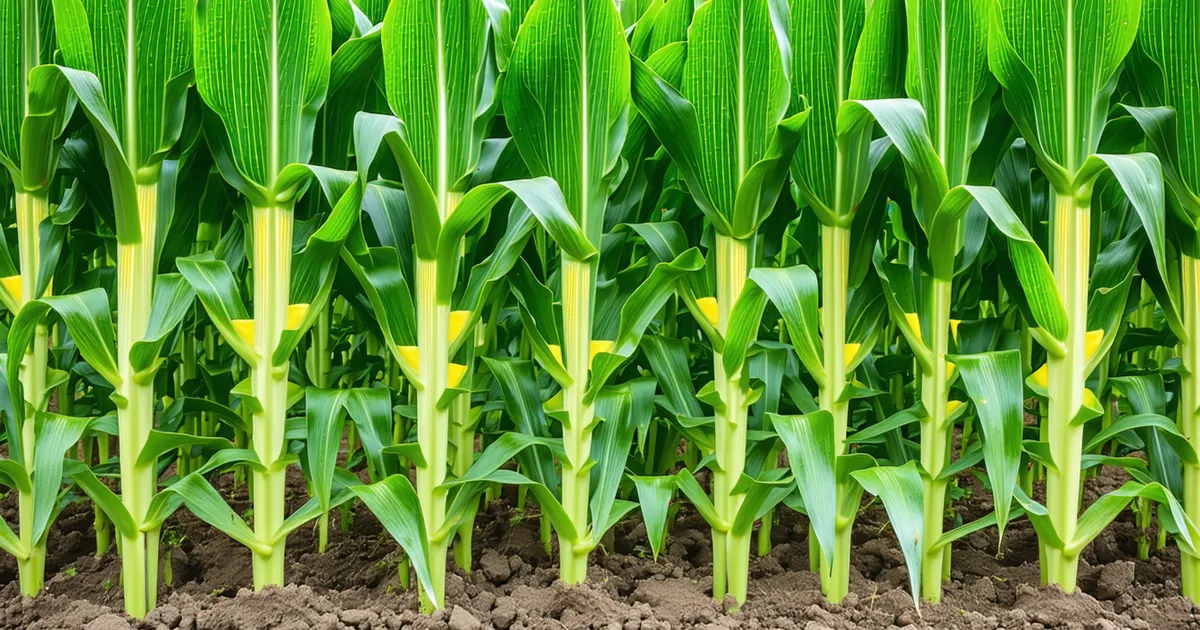
Nitrogen deficiency is the most common yield-limiting nutrient stress in Iowa corn, and it's also the one with the narrowest correction window. Once a corn plant reaches V8 to V10 — roughly knee-to-waist high in late May or early June — the growing point has moved above ground, the yield components for the first ear are being determined, and a rescue nitrogen application still has a meaningful chance of recovering potential. After R1 silking, that window has largely closed.
The agronomic question isn't whether to scout for nitrogen stress. It's whether you can find it while the window is still open.
What Nitrogen Deficiency Actually Looks Like from the Air
At V4 to V5, a corn plant with insufficient available nitrogen begins showing characteristic yellowing on the older, lower leaves — chlorosis progressing from the leaf tip toward the midrib in a V-pattern. This symptom is textbook on the ground, but from a drone at 200 feet, what you're actually seeing is a spectral signature shift: the canopy reflectance in the red-edge and near-infrared bands drops before the visible yellowing is apparent to the human eye.
Multispectral imagery — using bands beyond the visible spectrum — captures this shift. The NDRE (Normalized Difference Red-Edge Index) is particularly sensitive to early chlorophyll content decline. A field with a nitrogen-deficient block will show a measurable NDRE depression before those rows look noticeably different in a standard RGB photograph. This means aerial detection can flag a problem 5 to 10 days before ground-level walking confirms it, which matters enormously when the treatment window is only 3 to 4 weeks wide.
Standard NDVI (Normalized Difference Vegetation Index) is less sensitive at early growth stages because the canopy isn't yet closed — soil background noise dominates. NDRE, which uses the red-edge band around 730nm, is better calibrated for early-canopy chlorophyll estimation. This is why a simple RGB drone pass at V4 often misses what a properly calibrated multispectral flight will catch.
Why the Signal Is Spatially Concentrated
Nitrogen deficiency in Iowa corn rarely presents as a uniform field-wide problem. More commonly, it clusters in zones tied to underlying soil variability: low organic matter areas on eroded knobs, high-drainage sandy strips, or wet-year denitrification zones in low-lying tiles. These are often the same zones that show up in historical yield maps as chronic yield drags.
Consider a 480-acre corn operation in Boone County — a mix of Clarion-Nicollet-Webster soil associations typical of central Iowa. In a wet spring, the Webster soils in the lower field positions may have experienced significant pre-V6 leaching and denitrification even if pre-plant nitrogen was applied at agronomically correct rates. The Clarion hillslopes may be fine. A grid-based or whole-field nitrogen strategy misses this entirely. An aerial scan at V4-V5 will show the Webster zones as a distinct NDRE anomaly before the agronomist would catch it walking transect lines.
The spatial concentration also means that flag-and-walk is the right response — not a whole-field rescue application. Identifying that 40 acres of a 480-acre field need attention is a very different prescription than assuming the whole field is stressed.
The Pre-V8 Correction Window: What the Research Says
University extension agronomy research in the corn belt has consistently documented the relationship between nitrogen application timing and yield recovery. Applications made before V6 tend to recover close to the full yield gap created by early deficiency. Applications at V6-V8 still recover a meaningful portion — estimates in the range of 50-75% of potential loss depending on severity. After V10, recovery drops sharply.
We're not saying that a V8 diagnosis is useless — it isn't. But we are saying that a V5 diagnosis followed by a sidedress application with Y-drops or high-clearance equipment is materially more valuable than a V10 diagnosis that's too late for meaningful recovery. The window is measured in days, not weeks, at this crop stage. The first two weeks of June in central Iowa can be the difference between a correctable problem and a written-off yield.
It's also worth noting what rescue nitrogen can't do. If the nitrogen stress occurred during the V3-V6 period when the ear initiation is happening — specifically the determination of potential row number — some yield potential is already gone. Rescue nitrogen after V8 is maintaining what's left, not recovering what was lost. This makes early detection even more important than the treatment window alone suggests.
Confounds: What Aerial Nitrogen Detection Gets Wrong
The honest answer is that canopy reflectance doesn't read a soil nitrate test. There are several conditions where a NDRE depression will look like nitrogen deficiency but isn't:
- Sulfur deficiency: Classic nitrogen-like chlorosis, but starts on younger leaves rather than older ones. Aerial imagery can't always distinguish the two without ground-truthing.
- Waterlogged stands: Anoxic root zones impair nitrogen uptake even when soil N levels are adequate. The canopy looks nitrogen-stressed because it is, but adding nitrogen doesn't fix the problem.
- Seedling blight / stand issues: Thin stands show NDVI/NDRE depression for an entirely different reason — poor plant density rather than nutrient stress.
- Early gray leaf spot or northern corn leaf blight: At very early stages, foliar disease can create spectral signatures that overlap with nutrient stress.
This is why Fieldglint flags zones for investigation, not for automatic prescription. An aerial report that identifies a 40-acre NDRE depression in a Boone County field tells an agronomist: go to this zone first. What they find when they walk it determines the action — not the aerial signal alone. Ground-truthing is the last step, not an optional one.
Practical Workflow: From Flight to Sidedress Application
For a grower targeting pre-V8 nitrogen correction, the timing chain looks roughly like this: aerial flight at V4-V5 (typically mid-to-late May in Iowa), 48-hour report turnaround, agronomist verification walk on flagged zones, prescription written, sidedress equipment mobilized. From flight to application, you're looking at 5 to 7 days on a well-coordinated operation.
The bottleneck is usually equipment availability in late May, not the scouting information. High-clearance applicators and Y-drop attachments are in high demand across the corn belt during the V5-V8 window. Having a targeted prescription — "these 40 acres at the north end of Field 7, bounded by the drainage tile" — means you can book equipment time specifically rather than planning a full-field pass that may or may not be needed. That specificity has tangible economic value beyond the nitrogen savings.
For consulting agronomists managing multiple client farms across a county, the sequential problem is more acute. You can't physically walk every field in the V4-V6 window and respond to everything you find. Prioritizing which fields to visit based on aerial flags — "these three farms need attention this week; the other seven are clean" — is what makes the early-detection window actionable at scale.
Field Variability and the Follow-Up Flight
One pre-tassel flight won't capture every nitrogen stress event. A field that looked clean at V5 can develop stress symptoms by V8 if a stretch of wet weather in early June drives further denitrification. This is why a two-flight model — one pre-tassel and one post-tassel — gives a fuller picture than a single early scan.
The post-tassel flight serves a different function: it's less about correcting in-season deficiency (that window is mostly closed) and more about building the precision data record for next year's nitrogen management decisions. Which zones consistently underperform on nitrogen? Are they correlated with drainage class, tillage history, or cover crop residue? The yield map at harvest plus the in-season NDRE records begin to form a multi-year dataset that supports variable-rate nitrogen prescription maps — the step beyond rescue scouting into proactive zone management.
That longer-term data loop is where the real agronomic value compounds. A single season's aerial scan is useful for catching problems. Multiple seasons of aerial data across variable weather years is what builds a defensible, site-specific nitrogen management program.